
This wonderful song is a prayer, praise and a declaration of thanks to God. The melody carries rich words to rehearse in our minds and hearts. Please give it a listen, and come back for a chat about metaphors, similes, oxymorons, moms and more of God’s wonderful Word and works … all kinds of things to be thankful for.

A way with words
In a bit under two minutes this old hymn plays and then leaves the stage. Not a lot of time to ponder its depth. But, as with all great things, especially things of God, we find the more we dig, the more we find. Can you dig it?
This marvelous hymn includes some words that might cause us to scratch our heads if we’d pause to think about them. Right there in the first verse we sing “His world rejoices” .
But … but, literally, a “world” does not rejoice. People do.
Did the song writer make a mistake? Not at all!
Using “world” to mean “people” is a literary device called a figure of speech. Figures of speech are intentional shifts from literal language to colorful language. They are used to add emphasis.
“Let us be grateful to people who make us happy; they are the charming gardeners who make our souls blossom”
This is a figure of speech called a “metaphor“. It is not literally true — making me happy does NOT make you a gardener. But we still like the quote BECAUSE it expresses an idea colorfully and powerfully.
Act naturally — Deafening silence — Growing smaller —
Jumbo shrimp — Only choice — Original copy —
“We’re busy doing nothing.” ( – Bing Crosby)
These are examples of another figure of speech: “oxymoron” — where words are combined that seem to contradict each other. Aren’t these clever, colorful ways to communicate?
Some people may use the term “figure of speech” to mean sloppy talking. Students of language know these are anything BUT sloppy talking. Figures of speech are deliberate departures from LITERAL language for the purpose of expressing a truth more powerfully and colorfully.
Both metaphors and oxymorons tweak language to add emphasis and color but they each use a different pattern.
The metaphor pattern is to compare similar things.
The oxymoron pattern is to join things that don’t seem to belong together.
Can you think of any other figures of speech? Simile? Hyperbole? So far that’s FOUR figures of speech. Don’t stop yet! On the internet today I saw an article listing “the EIGHT figures of speech”. (Always trust what you read on the internet, right?!?)
Eight?!? Whoops, whoopsie!
I’ve heard people getting PhDs in language arts might learn as many as 20 to 30 different figures of speech. That’s impressive. BUT — that only hints at how much we DON’T know that previous generations knew.
Shakespeare lived and wrote around 400 years ago. Scholars see about 100 different figures of speech in his writings. (And we think WE have become so smart!)
Figures of speech in the Bible
The Bible is rich beyond our imagination. No surprise, considering its Author.
A Bible scholar from the late 1800’s, E.W. Bullinger, studied figures of speech. He found about 220 kinds of figures of speech used in literature and he cataloged about 217 different kinds of figures of speech in the Bible! Some of these kinds of figures of speech have more than a dozen variations. (For more see [click] “figures of speech” appendix from Bullinger’s Companion Bible elsewhere on this website in “The Music Box”. There you might find a name for the figure where “world” is used for “people”.)
Not recognizing figures of speech in the Bible might cause us to miss emphasis God intended. I’ll offer this example. Read Genesis chapter one and notice the repetition of the word “and”. We see many ands. That is the figure of speech “polysyndeton” (means “many ands”). When we see many ands, the figure of speech wants us to slow down and notice every item listed.
If “many ands” is a figure of speech, do you think there could be a figure that leaves “ands” out? Indeed, there is — it is called “asyndeton” (means “no ands”). Example: Galatians 5:22,23: “But the fruit of the Spirit is love, joy, peace, longsuffering, gentleness, goodness, faith, meekness, temperance: against such there is no law.” Nine items listed but no ands. This figure puts the emphasis on the conclusion, rather than on the list leading up to it. The emphasis is: “against such there is no law.” Not knowing the figure “asyndeton” we STILL get the general idea, but we might miss the emphasis God intended. Not life and death, but WE miss some of the greatness of God and His Word.
It would be a mistake to look at “odd” manners of expression in old literature and explain it away by thinking the old-timers did not have well-developed rules of grammar. In fact, it is just the opposite. WE have lost the rules of grammar THEY recognized. How did THEY learn these forms of language arts? Don’t underestimate the role studying Scripture has played throughout history in making people smart.
One thing for sure: the more we learn about God and His wonderful works, the more we realize how big HE is, and the more we want to draw close to Him. I’m glad He loves us, aren’t you?
So much to be thankful for
This hymn has been helping folks be thankful for almost 400 years. Pause and consider this phrase “tossed in” to the first verse: “♪♫ Who from our mothers’ arms …♪♫”
How did Mom — actually, ALL mothers — get into this song about “we all” thanking and praising God? Through inspired genius, I suspect. Our songwriter is pointing out in passing how God has blessed us BY DESIGN. His design is for every person to be born of one mother. Not hatched in a batch in some icy stream. Not sprouted from a sprig and dropped to the ground. No, each person enters this world by one specific person, Mom, who, by God’s design, is there to care for and raise, and love that child.
Mothers — by God’s design — how amazing! How wonderful! Thank you, Lord!
As a mini workshop on praise and thanksgiving, this old hymn hits the ground running. In opening line we sing:
When? NOW
What? WE ALL THANK
Who? OUR GOD
How? WITH HEART (sincere enthusiasm from the core of our being)
How? WITH HANDS (our service)
How? WITH VOICES (speaking and singing the wonderful works of God)
When I write it out like this, the ideas seem CLEAR but CLUMSY. But how powerful and memorable these words become when they are sung! Ah, the wonders of a good song!
Up! Up! Don’t miss the richness of so many truths this song touches in less than two minutes. I’ll close by inviting you to find the line in this song about the hope of Christ’s return and the blessings of the life to come. Do you see it? [Find lyrics printed below.] You’ll need to read and think. (Hint: the lyric uses the huge small word: “in“. Huge small … is THAT an oxymoron?)
What now? Let’s thank we all our God!
God bless you lots,
-Dale R.
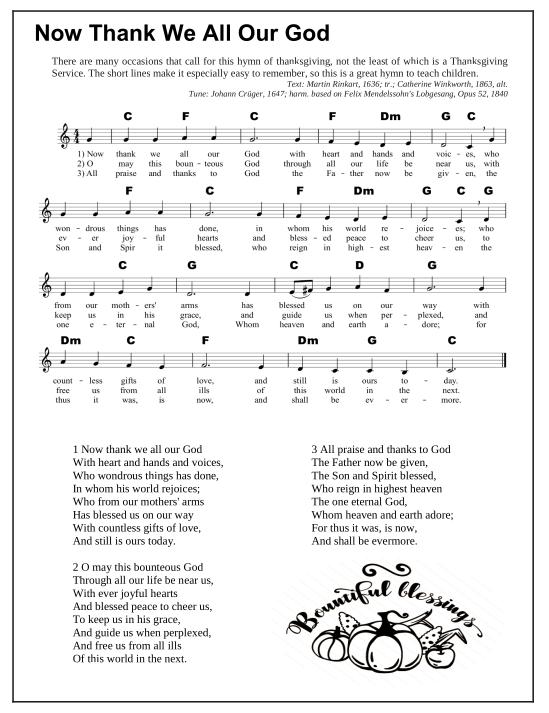
LYRICS: Now Thank We All Our God
Words by: Martin Rinkart (1636)
1. Now thank we all our God
With heart and hands and voices,
Who wondrous things has done,
In whom His world rejoices;
Who from our mothers’ arms
Has blessed us on our way
With countless gifts of love,
And still is ours today.
2. O may this bounteous God
Through all our life be near us,
With ever joyful hearts
And blessed peace to cheer us,
To keep us in His grace,
And guide us when perplexed,
And free us from all ills
Of this world in the next.
3. All praise and thanks to God
The Father now be given,
The Son and Spirit blest,
Who reign in highest heaven
The one eternal God,
Whom heaven and earth adore;
For thus it was, is now,
And shall be evermore.
Share your thoughts
I’d love to hear from you. Please jot a greeting or comment below in “Leave a reply”.
Thanks for visiting. – Dale R.😊
Posted November 14, 2019
Reposted with changes to notes and video October 16, 2026
Good Afternoon Dale,
Great song. Do I not remember it from church long ago? So thoughtful of you to stir that pleasant memory. Especially with your great finger picking and melodic singing. By the way, I got together with Glenn Weiss this am for an orientation class at one of the venues I serve at. I am pretty sure that you met him. He is the one that played the mandolin with Jack and Mike over at Jack’s house. Glenn is going to start helping us out with worship.
Blessings,
Daniel R
Wonderful song! I’ve loved the tune also, it’s how I remembered I knew and sang this at one time.
Answer: “And free us from all ills
Of this world in the next.” [Delete if needed :-)]
I love the song, the sermon and the pictures!
Craige – you get five gold stars! Thanks for your note. God bless ya – Dale