
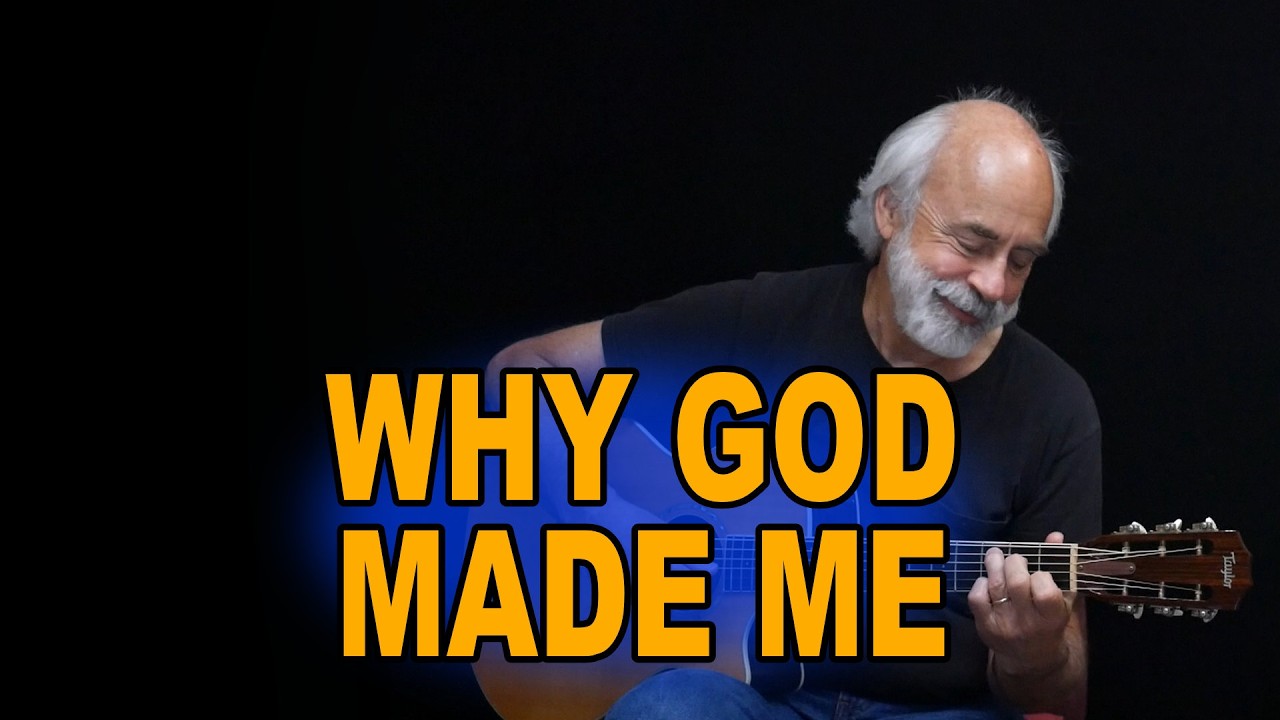
Years ago I took a class that claimed it could deliver a number of attractive benefits. One of the claims was “makes life meaningful”. (I should mention it was a class on the Bible, and it was from that book each of the promised benefits were drawn — and were indeed delivered.) This new song, “Why God Made Me” — by Charlie Johnston — nestles right into the joy that accompanies that kind of learning, and especially reminds me of thrill it was to see the promise of “makes life meaningful” light up for me all those years ago. Give it a sing-along listen, then come back for a chat on some of the statistically impossible wonders of divine design that could be the work of none other than our Father God, and where you and I fit right into His plan for each and all to have meaningful lives.
What are the chances?
In scene from the comedy film “Dumb and Dumber”, Jim Carey’s character is being solidly rejected by a romantic interest. He asks if there is any chance for them. When she answers “one in a million” we understand her perfectly — zero chance. But we are not dumb or dumber. No, but he brightens up and says “so you are saying there is a chance!” We laugh because we know she means his dream is “functionally impossible” but he is dumb enough to take hope in the ridiculously thin particle of light poking through the expression “one in a million”. “Extremely improbable” is all he needed to keep his dream alive. (We notice she was speaking “figuratively”, which added a little sting to her “zero chance” answer. But in our “hero’s” defense, literally, at a chance of “one in a million” — or 10^6 — ten to the sixth power — things probably do happen every day somewhere on earth. And hope springs eternal.)
In the worlds of statistics and physics you will find a serious debate on where “extremely improbable” ends and “functionally impossible” begins. And in that debate, the numbers are way, way past that one in a million we just looked at.
A French mathematician named Borel made a case for functional — or statistical –impossibility being reached when the chances hit one in 10^50 (“one in ten to the fiftieth power”, or 1 followed by 50 zeros.) How big is that? Well, If you were to try to count to that number, and you counted one billion numbers every single second, it would still take you roughly 3 sextillion (3,000,000,000,000,000,000,000) years to finish. So, no rush … take your time.
Ever heard the question how long would it take for a monkey hitting random keys on a typewriter to type all the words of Shakespeare? Well … a very long time, indeed. The math speculates the chances of a monkey typing just the first 80 letters of a book correctly is about one in 10^100. According to Borel, that is statistically impossible.
But, others argue for yet a higher bar to qualify for statistical impossibility placing it at one chance in 10^150, or 1 followed by 150 zeros.
So what? The question is, how unlikely does something need to be before we should finally give God credit for it?
Statistical impossibilities all around us
There are all kinds of statistical impossibilities to study — ones that should get reasonable people seeing God’s handiwork there. Here are a few for starters.
EARTH: Having even a single planet in the entire universe that supports life the way our beautiful Earth does qualifies as a statistical impossibility. Consider just a few of the factors that, when combined, are easily judged as plenty to get us past that “10^150” or “ten to the one hundred fiftieth power” threshold:
- The right neighborhood: Our solar system happens to be in a “safe” part of the Milky Way. There are plenty of neighborhoods in the universe that would not do — too hot, cold or peppered with killer asteroids.
- The right star: The sun is just right — not too hot, not too cold. There are plenty of stars which would either freeze or cook us.
- The right orbit: 5% closer to the sun and we’d be too hot, like Venus. 20% further and we’d be frozen like Mars.
- The Earth’s magnetic shield: Without that the solar wind could blow away our atmosphere and take our breath away, to say the least.
- The Moon is an anchor: Without the moon the Earth would wobble horribly, and even Florida would be a terrible climate to live in. Having such a moon? Highly unlikely.
- Moving Earth Plates: This action works like a thermostat, recycles carbon dioxide, and creates necessary activity for soil to be able to grow things. Add to that, water makes this movement possible by lubricating the plates. Think of all the other things depend on water, too! The abundance of water deserves its own bullet here…
- Jupiter: Jupiter acts like a giant space vacuum cleaner that draws comets and asteroids away from the Earth. Without it, probability says the Earth would be killed by space rock collisions about every thousand years. (I suppose it would only take one …). Chances of having such a perfect vacuum cleaner planet just the right distance from us? Highly unlikely.
The list could go on and on, but I think this is a good start.
LANGUAGE: This is so fascinating to study. It is huge! I’ll just say that the origin of language has been called “the hardest problem in science”. Even surpassing where the Earth came from. Sure, everyone’s talking, so we might not think much of it. But the more people dig into how language got here, the more baffled they become. It is a total statistical impossibility. Yet even babies pick it up. Go figure! Look into this more. Amazing!
US AIRWAYS FLIGHT 1549: On January 15, 2009, a commercial airliner with 155 people on board took off from New York City. Two minutes after takeoff, the plane hit a flock of birds, killing both engines. Just 208 seconds later, the pilot was able to land this 70 ton glider in the cold waters of the Hudson River. All 155 people on board survived and there were almost no injuries. What were the chances?
This is another fascinating study! When all the factors are added in, we can once again speak of “statistical impossibility.” Just the bird strike taking out both engines in aviation terms is considered statistically impossible. Add this super-rare event, the super-rare level of training and experience of that pilot, Chesley Sullenberger (“Sully” — DO see the movie — great story!). Combine the event and the skill set, let alone other variables, and you get into genuine “statistical impossibility”. It has been said of this incident that “a man with a one-in-a-million level of preparation was met by a one-in-a-billion emergency.”
So, just wild coincidence? Or yet another “hand of the Lord” wonder? A large number of people who survived that incident are certain it was the Lord. Not to mention most people who hear the details. God is good!
Makes life meaningful
What about a meaningful life? What shall we say?
A key to living with power, love and a sound mind is to recognize the hand and heart of God Almighty in the design of the universe and in His dealings with His creation, including you and me. Here is some food for thought from the Bible:
Are not five sparrows sold for two pennies? Yet not one of them is forgotten by God. Indeed, the very hairs of your head are all numbered. Don’t be afraid; you are worth more than many sparrows.” [Luke 12:6,7]
He has shown you, O man, what is good. And what does the LORD require of you but to act justly, to love mercy, and to walk humbly with your God. [Micah 6:8]
When all has been heard, the conclusion of the matter is this: Fear God and keep His commandments, because this is the whole duty of man. [Ecclesiastes 12:13]
God sees you, knows you and loves you.
The fun of obedience is finding out what God has in mind.
Charlie Johnston has given us another lovely, thought provoking song. (By the way, do yourself a favor and go straight over to Amazon and buy a copy of his recent book “Spiritual Perception & Awareness” by Charlie P. Johnston Jr. With great heart and good thinking he walks us through a number of Biblical truths, suitable for kids of all ages, that will get you thinking better about a number of things worth thinking better about. Good book for reading, studying and sharing.)
Charlie’s song got me thinking about those exciting days so many years ago when my friends and I were first learning from the Bible what “makes life meaningful”. His song also reaffirms how searching the scriptures and doing what they say are two keys I was given to use day after day to help me continue to learn why God made me.
God bless you lots!
–Dale R.
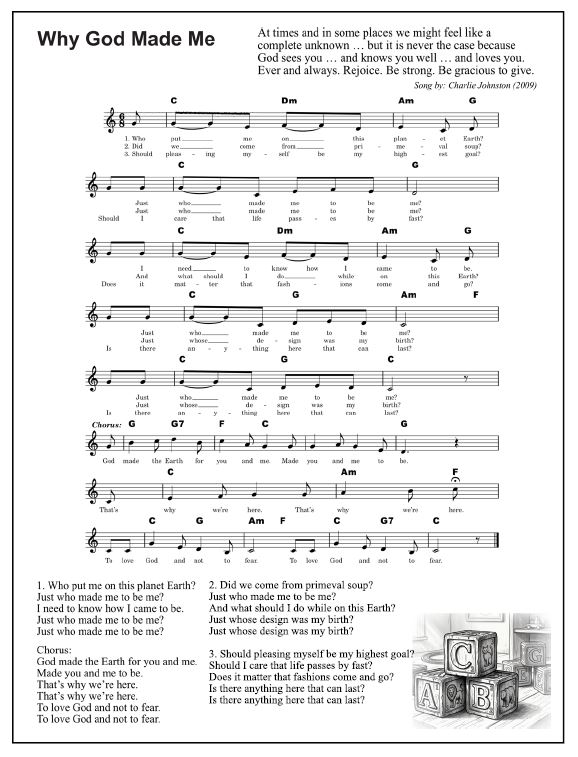
LYRICS: Why God Made Me
Song by Charlie Johnston (2009)
1. Who put me on this planet Earth?
Just who made me to be me?
I need to know how I came to be.
Just who made me to be me?
Just who made me to be me?
Chorus:
God made the Earth for you and me.
Made you and me to be.
That’s why we’re here.
That’s why we’re here.
To love God and not to fear.
To love God and not to fear.
2. Did we come from primeval soup?
Just who made me to be me?
And what should I do while on this Earth?
Just whose design was my birth?
Just whose design was my birth?
3. Should pleasing myself be my highest goal?
Should I care that life passes by fast?
Does it matter that fashions come and go?
Is there anything here that can last?
Is there anything here that can last?

Say hello … leave a note … add your thoughts
Please feel free to add your thoughts to this conversation. Scroll to the bottom of the page and jot your note in the “comments” box just below the “Leave a reply” title. Easy! Thanks!
— Dale R.
Good Evening Dale,
I love this one too. You are awesome!!!!
Thanks, Dan. You are too kind! Love you — D.
Love the science facts!! 🤓 Fascinating!! Thank you for posting!
Sarah, thanks for your note! To Mars and beyond, right?!? God bless you lots — D.
Thank-you so much for recording this song, Dale. As we grow older I think that question becomes more and more important to answer.
(Appreciated the plug on the book also.)
God Bless,
Love-in-Christ,
Carol