
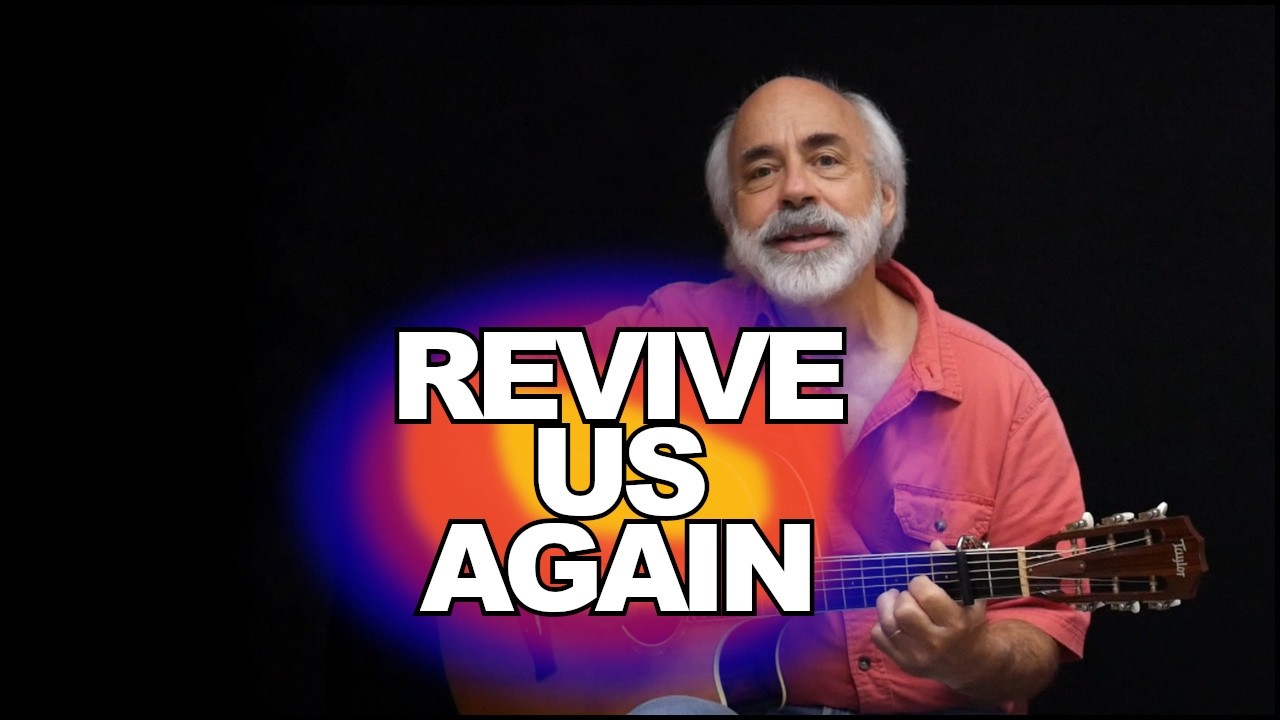
I’m aware of America Top 40 and Billboard Hot 100, which are lists of the most played songs of the past week. I wondered about any “hit lists” for hymns — and was fascinated to find what I’ll call “top-thousand-so-far” collections. I cannot claim scientific precision on the counts, but by several measures — including its age (160 + years) and appearance in 1,454 hymnals we know of — it is safe to consider our song “Revive Us Again” as being in the “Top 100 Hymns of the Past Two Centuries”. It has remained popular all these years for exciting reasons we’ll look into in the song notes. Please give it a sing-along listen and then join me for a chat.
Practice makes perfect
I’ve kept a music student’s mindset most of my life. I could treat a bunch of you to a nice dinner out if I had a nickel for every time I’ve heard “practice makes perfect.” (Or, better yet, “perfect practice makes perfect”, which, by the way, produces much quicker results. An easy concept I’d be happy to share. Drop me a note below to request more. 😊) Recently the admonition in Hebrews 13:2 lunged off the page at me as a “practice tip”: “Do not neglect to show hospitality to strangers, for thereby some have entertained angels unawares.” This verse challenged the habit I practiced. My habit has NOT been to expect a stranger to be an angel. Honestly, I likely would not even give it a serious thought — as a habit.
“Expectation” is huge and fascinating as a lever for results. It has been said that our expectations are a filter. The person who agrees that a stranger just might be an angel will likely act differently from the person who has no such thought because their expectations provide different filters on how they interpret the encounter. I’m thankful for angels but I don’t usually expect to see them. Hebrews encourages me to adjust my expectation so I’ll remember it is possible a stranger could be an angel. Wouldn’t THAT be something to write home about!
Let’s look at “expectation filters” when it comes to songs. There are all kinds of songs which can serve all kinds of purposes. I think anyone who can name more than two songs probably has figured out songs can be put to work for different purposes. When I sing a “silly” song, I expect to feel the fun and maybe even see grins. When I sing a lullaby, I expect to feel calm and to see eyelids soon. We keep songs that do something for us.
Our song “Revive Us Again” isn’t a “silly” song, certainly not a lullaby. It is about two things: praising God and requesting revival. That’s serious stuff, and deserves an appropriate expectation. Here is an idea — before singing songs that deal with such great matters, I would like to remember that admonition from Hebrews and think something like this: “Do not neglect to pay attention to what you are singing, for thereby some have received miracles of deliverance.”
Music and miracles
If we’ll just read the Bible and live life awhile we cannot help but marvel at how many ways the Lord can get things done. I’ve heard it said “Jesus never healed the same way twice”. 2 Chronicles chapters 5 and 20 hold treasures for us to consider today, both involving music, miracles and God’s powerful presence at the scene.
First let’s read about King Solomon and the dedication of the phenomenal new Temple in Jerusalem:
All the Levite singers—Asaph, Heman, Jeduthun, and their sons and relatives—stood on the east side of the altar, dressed in fine linen and playing cymbals, harps, and lyres. They were accompanied by 120 priests blowing trumpets.
The trumpeters and singers joined in unison to praise and thank the Lord. Accompanied by trumpets, cymbals, and other instruments, they raised their voices and praised the Lord, singing:
“He is good;
His loving devotion endures forever.”
Then the temple, the house of the Lord, was filled with a cloud
so that the priests could not stand to minister because of the cloud, for the glory of the Lord filled the house of God. [2 Chronicles 5:12–14 BSB]
Can you imagine the sound from 120 trumpets? I’ll bet the acoustics in the temple were stunning. The singers raised their voices and praised the Lord, singing: “He is good; His loving devotion endures forever.”
I find it fascinating that the temperature of the gathering was such that “the house of the Lord was filled with a cloud, so that the priests could not stand to minister because of the cloud, for the glory of the Lord filled the house of God.” It is almost as if the people had their hearts and energy so “right” that the Lord Himself told the priests to sit this one out, and He Himself took over the program. It must have been awesome. I bet the singing was swinging.
The next record, in 2 Chronicles 20, gives us one of the many ways God delivered His people. The method was remarkable — and it involved music.
To paraphrase — King Jehoshaphat of Judah faced a massive crisis when a vast coalition of armies marched to attack and wipe out Israel. Jehoshaphat proclaimed a nationwide fast and prayed for divine help. God answered through a prophet, declaring the battle belonged to Him. The next morning, Jehoshaphat placed a choir at the front of his army to sing praises. As they sang and worshiped, the Lord confused the enemy armies, causing them to destroy each other. Judah collected immense plunder without lifting a sword, bringing peace to the kingdom.
Given the urgency of the situation, I bet that choir did not phone in the song that day. They showed up knowing what the enemy intended and believing God’s promise of victory. I’m confident they put their hearts into it.
Only about 85 years separated these records involving glorious, wise King Solomon dedicating the temple and his great-great grandson, King Jehoshaphat facing the military crisis. What makes the connection between these two chapters so incredible is that when Jehoshaphat’s choir marched out in chapter 20, they sang the exact same song of praise (“He is good; His loving devotion endures forever”) that their ancestors sang in chapter 5 to bring down the glory cloud. How’s THAT for a song that served at significant times? I’ll bet this song could not be sung without inspiring the fullest voices and wettest eyes.
Most of the time choirs don’t sing with so very much at stake, praise the Lord. Every day is not “D-Day”. But on the other hand, how often do we sing a great song like this when there is nothing at all at stake? There’s almost always someone in the room or in mind with something that needs to move. God’s promises for deliverance in every area of life stand. It is Christ in you, the hope of glory. God so loved — and so loves!
Let’s grow in our expectations so when we lift our voices to praise the Lord and make requests according to His will that our hearts are open and arms outstretched to welcome His glory and receive His answer of peace, of deliverance and of love. Let’s live — and sing — with the expectation that we, too can see our own miracles today.
Revive Us Again
So, how about this song — “Revive Us Again”. Why might so many people have come back to this song time after time? What have they come to expect it to do for them? You can probably answer that for yourself just fine. I’ll toss a few thoughts on the table.
I love how it puts praise first, before asking for anything. A LOT of praise. What peace and strength fill our hearts and minds when we direct them to honor God, and His Son, our Lord and Savior Jesus Christ, and embrace the gift of holy spirit that has been poured out.
I love how the lyrics are organized so we sing that way for four verses. Then after singing praise to the Lord and His wonderful gifts and benefits to us … the fifth verse finally, wholeheartedly, joins along with the last phrase of the chorus, offering a single request — revive us again. The request clearly harmonizes with the Lord’s will, so we can be confident He will fill it.
I love how the song’s request makes this revival’s tent the largest it could be. “Revive us again” includes everyone.
I love how it can bring us to this kind of mind: “Lord, in You we have life to the fullest. Here, again, today, we praise You, we bless You, we glorify and honor You. Now, please one more time — fill us to overflowing with your glorious presence, fire us up yet more, continue to scatter the darkness of night and shed light on our path as we joyfully walk with You. In all this and through all this,Lord, we ask that in Your tireless mercy and grace … revive us again.”
God bless you LOTS!
–Dale R.
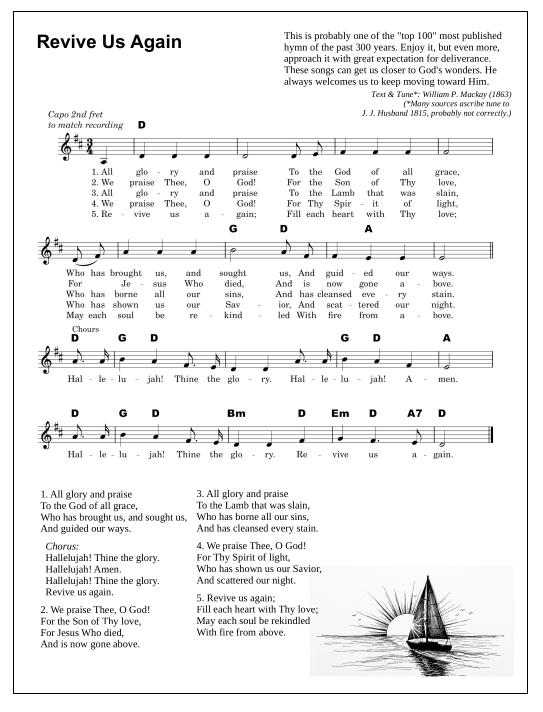
Download this songsheet from “The Music Box”
LYRICS – Revive Us Again
Text & tune*: William P. Mackay (1863)
(*Many sources ascribe tune
to J. J. Husband 1815,
probably not correctly.)
1. All glory and praise
To the God of all grace,
Who has brought us, and sought us,
And guided our ways.
CHORUS:
Hallelujah! Thine the glory.
Hallelujah! Amen.
Hallelujah! Thine the glory.
Revive us again.
2. We praise Thee, O God!
For the Son of Thy love,
For Jesus Who died,
And is now gone above.
3. All glory and praise
To the Lamb that was slain,
Who has borne all our sins,
And has cleansed every stain.
4. We praise Thee, O God!
For Thy Spirit of light,
Who has shown us our Savior,
And scattered our night.
5. Revive us again;
Fill each heart with Thy love;
May each soul be rekindled
With fire from above.
Say hello … leave a note … add your thoughts
Please feel free to add your thoughts to this conversation. Scroll to the bottom of the page and jot your note in the “comments” box just below the “Leave a reply” title. Easy! Thanks!
— Dale R.