
And now for something completely different. This song, “Thanks Be to God”, is a colorful example of a 19th-century genre called “Providential / Harvest Thanksgiving” hymns. Both that genre’s name and this song were new to me. The song has features that fascinate. Here we find enthusiastic thanksgiving expressed with a poet’s flare, speaking both of natural and cultivated outdoor beauty — and, of course, giving thanks to God and His Son. The artsy poetic lyrics are set in motion through the songwriter’s skilled handling of mixed meters and melodies. The style might take some warming up to, but I think most would agree the song is admirable and not difficult to enjoy. I gather this song did not make it into “main church pew hymnals”, but the song’s two pages did made it into www.Hymnary.org as part of an 1875 Sunday School collection called “The Shining River: A Collection of New Music for Sunday Schools“. Give it a sing along listen, then let’s talk about something the good Lord has made easy for us.

The art was no accident
As I said, the song was new to me. So was the songwriter, and because of craftsmanship displayed in this song I wanted to learn about him. Such praise and thanksgiving, set in such artsy poetic style and “fancy” musical features, led me to think the writer must have had some training in the field.
It turns out he most certainly did, to put it mildly. I’ll try to summarize — Henry Southwick Perkins was born in Vermont in 1833 and lived 81 years. He was the son of musical parents who taught this future music teacher. He attended “some of the best literary schools”, graduated from Boston Music School, and spent many years conducting music festivals all over America from Maine to California. He taught music in eight different states and was a Professor of Music at the University of Iowa. He composed vocal music for choirs, Sunday school, public schools, choir societies, conventions and festivals. He organized state and national Music Teacher Associations, established a music college, published several hymn books … you get the picture.
Mr. Perkins was man of letters and musical notes. He wrote and published Christian music for non-denominational outreach and worship, and was also a notable contributor in secular music education and performance. He was one of those who served capably in the Lord’s Kingdom’s work on both sides of the church’s door.
We can more easily understand the “fanciness” of our song “Thanks Be to God” when we learn it was “written and composed for the Sunday School Convention, Picnic,and Musical Festival exercises at the Natural Bridge, Lexington, VA, July 23, 1875”. This song was a music festival show piece — music made for a gathering of musicians — with a view that it would be performed in a beautiful spot of nature. Artsy music which blended in with amazing outdoor surroundings. It is a hymn of praise and thanksgiving produced and performed for a picnic. I’ll bet the food was good, too!
I appreciated this song more after learning how accomplished the songwriter was and why the song was written. I’ve found I can be quick to say “something” is not “my thing” and miss out on the inspiration to grow that I might have received if I had instead appreciated the value and beauty invested into the “thing” by its maker.
I often make scrambled eggs for breakfast. Just this week I stumbled onto a YouTube video called “Stop Making Scrambled Eggs Wrong — Every Chef Secret for Perfect Scrambled Eggs Every Time”. I invested the 15 minutes to watch it. Twelve techniques presented. Changed me into a smarter egg. I’ve heard it said “there is a technique for everything!” Let’s never lose our curiosity in this life!
We benefit when we see the good in another person’s accomplishment. And how much more do we gain when we pause to recognize and appreciate work the good Lord has done — and is doing?
Learning to see the good in things chases away discontent and feeds thankfulness.
Thankfulness is almost always a good fit.
Thankful for all that
In the lyrics on the video we find “Thanks” 16 times in various combinations:
Thanks be to God 11 times.
Thanks for:
— all nature around us,
— Perfumes … in the breeze;
— the fruit
— the flowers,
— songbirds
— forests
— trees
— friendship (as we gather)
— all things that bring us good cheer
Thanks to our Heavenly Father,
Whose care He so richly bestows;
Thanks to His Son our Redeemer,
Whose measure of love overflows;
How beautiful and appropriate to thank the Father and His Son for their blessings, love and providence! God is so good … and His works are magnificent.
Easy to be thankful
You’ve heard of first world problems?
You are resting comfortably in bed, only to discover the charging cable is exactly two inches too short for you to lie down on your side. Waiting through an unskippable 5-second ad for a 6-second video. Having to log into an app that usually remembers you automatically. Losing Wi-Fi connection for five seconds and acting as if civilization has collapsed.
Okay, these are stacked with indoor/smart phone type problems, but it helps to make this point: it is amazing how easy it is to become thankful when we “get real” and “unplug”. Go outdoors to be blessed by natural — and cultivated — beauty. Let your senses find the perfumes in the breeze, flowers, songbirds, forests and trees, and let them elevate your mood. And on another front, cultivate friendships. Enjoy people and see what they do well. Learn to recognize what brings good cheer.
Marvel at the works of the Lord.
And be thankful.
Oh give thanks to the LORD, for He is good; for His steadfast love endures forever!
[1 Chronicles 16:34 ESV]
May our lights shine as we with glad hearts and grateful voices declare this day and always “thanks be to God”.
God bless you lots!
-Dale R.
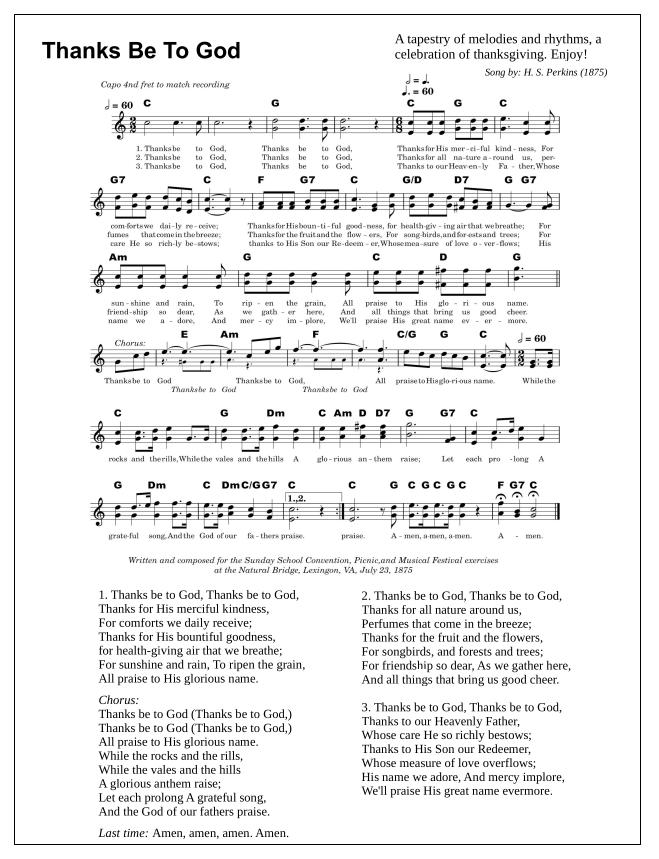
Download this song sheet from The Music Box
LYRICS – Thanks Be To God
Song by: Henry Southwick Perkins (1875)
1. Thanks be to God,
Thanks be to God,
Thanks for His merciful kindness,
For comforts we daily receive;
Thanks for His bountiful goodness,
for health-giving air that we breathe;
For sunshine and rain,
To ripen the grain,
All praise to His glorious name.
Chorus:
Thanks be to God (Thanks be to God,)
Thanks be to God (Thanks be to God,)
All praise to His glorious name.
While the rocks and the rills,
While the vales and the hills
A glorious anthem raise;
Let each prolong
A grateful song,
And the God of our fathers praise.
(Last time:)
Amen, amen, amen.
Amen.
2. Thanks be to God,
Thanks be to God,
Thanks for all nature around us,
Perfumes that come in the breeze;
Thanks for the fruit and the flowers,
For songbirds, and forests and trees;
For friendship so dear,
As we gather here,
And all things that bring us good cheer.
3. Thanks be to God,
Thanks be to God,
Thanks to our Heavenly Father,
Whose care He so richly bestows;
Thanks to His Son our Redeemer,
Whose measure of love overflows;
His name we adore,
And mercy implore,
We’ll praise His great name evermore.

Share your wisdom with other readers ...
Please feel free to add your thoughts to this conversation in the “Leave a reply” spot below.