
“O give thanks unto the LORD; for he is good: for his mercy endureth for ever.” So begins Psalm 136, the psalm Isaac Watts paraphrased to give us this song “Give Thanks To God Most High”. Please give it a sing-along listen, then come back and we’ll go on a treasure hunt exploring the Psalm and the song.

Watts up
Let the word of Christ dwell in you richly in all wisdom; teaching and admonishing one another in psalms and hymns and spiritual songs, singing with grace in your hearts to the Lord. (Colossians 3:16)
This is a one-verse description of Isaac Watts’ ministry. Watts (1674–1748) was an English minister, theologian, and prolific hymn writer who transformed congregational singing by crafting biblical, doctrinally rich hymns and Christianized versions of the Psalms. Charles Spurgeon, who was called “the prince of preachers” made much use of Watt’s hymns in his teaching ministry. Regarding Watts’ songs, Spurgeon said “We want no better theology and no better religion than are set forth in these hymns.” He was a big fan of Watts’ work.
About a century before Spurgeon, the cleric and theologian, John Wesley, who sparked the Methodist movement through field preaching and small-group discipleship, also put Watts’ songs to work. Wesley’s view was that ordinary churchgoers learn their doctrine from hymns far more than from sermons or theology books—and he placed Watts’ hymns at the very top of his recommended repertoire.
Isaac Watts wrote hymns and gave English-speaking congregations a complete “system of praise” drawn from Colossians 3:16 (“psalms, hymns and spiritual songs”). He wrote somewhere around 600 — 750 hymns and metrical psalms, plus dozens of children’s songs and sacred poems. He’s been called the “Father of English Hymnody.”
Watts, Psalms and songs
Our song “Give Thanks To God Most High” is part of a large work Watts released in 1719 called The Psalms of David Imitated in the Language of the New Testament. It includes 138 of the 150 Psalms. Interesting to note he omitted a dozen psalms — such as imprecatory psalms — that he felt didn’t fit Christian congregational singing as written. In his Preface, Watts explained his method: he wanted to “make David speak like a Christian” by taking an Old Testament Psalm and letting it naturally blossom into the New Testament Gospel at the climax. We can see that “blossoming” in this paraphrase of Psalm 136.
The full version of his song has 10 verses, but many hymnals include a shorter 4-verse version which is the one I recorded here. The 4-verse version (using verses 1, 8, 9 and 10) leans more to the “Christian blossom” and leaves out most of the Old Testament history (found in verses 2-7). This table maps Psalm 136 to Watts’ paraphrased 10 verse version. Look at the rich Bible history and testimony to God’s goodness and providence carried both in the Psalm and Watts’ paraphrase lyrics:
| Stanza | Primary Scripture Reference | What Watts Is Paraphrasing |
|---|---|---|
| 1. Give thanks to God most high, The universal Lord; The sovereign King of kings; And be His grace adored. His power and grace Are still the same; And let His name Have endless praise. | Psalm 136:1–3 | “O give thanks unto the LORD; for he is good… O give thanks unto the God of gods… O give thanks to the Lord of lords.” |
| 2. How mighty is His hand! What wonders hath He done! He formed the earth and seas, And spread the heav’ns alone. Thy mercy, Lord, Shall still endure; And ever sure Abides Thy Word. | Psalm 136:4–6 | “To him who alone doeth great wonders… To him that by wisdom made the heavens… To him that stretched out the earth above the waters.” |
| 3. His wisdom framed the sun To crown the day with light; The moon and twinkling stars To cheer the darksome night. His power and grace Are still the same; And let His name Have endless praise. | Psalm 136:7–9 | “To him that made great lights… The sun to rule by day… The moon and stars to rule by night.” |
| 4. He smote the first-born sons, The flower of Egypt, dead; And thence His chosen tribes With joy and glory led. Thy mercy, Lord, Shall still endure; And ever sure Abides Thy Word. | Psalm 136:10–12 | “To him that smote Egypt in their firstborn… And brought out Israel from among them: With a strong hand, and with a stretched out arm.” |
| 5. His power and lifted rod Cleft the Red Sea in two; And for His people made A wondrous passage through. His power and grace Are still the same; And let His name Have endless praise. | Psalm 136:13–14 | “To him which divided the Red sea into parts… And made Israel to pass through the midst of it.” |
| 6. But cruel Pharaoh there, With all his host, He drowned; And brought His Israel safe Through a long desert ground. Thy mercy, Lord, Shall still endure; And ever sure Abides Thy Word. | Psalm 136:15–16 | “But overthrew Pharaoh and his host in the Red sea… To him which led his people through the wilderness.” |
| 7. The kings of Canaan fell Beneath His dreadful hand; While His own servants took Possession of their land. His power and grace Are still the same; And let His name Have endless praise. | Psalm 136:17–22 | “To him which smote great kings… And gave their land for an heritage… Even an heritage unto Israel his servant.” |
| 8. He saw the nations lie All perishing in sin, And pitied the sad state The ruined world was in. Thy mercy, Lord, Shall still endure; And ever sure Abides Thy Word. | Psalm 136:23 (bridged to) Romans 3:9–23 & Ephesians 2:1–4 | Psalm 136:23 says, “Who remembered us in our low estate.” Watts expands Israel’s “low estate” into the universal human condition of a ruined world perishing in sin. |
| 9. He sent His only Son To save us from our woe From Satan, sin, and death, And every hurtful foe. His power and grace Are still the same; And let His name Have endless praise. | Psalm 136:24 (bridged to) John 3:16, Colossians 2:15, & 1 Corinthians 15:54–57 | Psalm 136:24 says, “And hath redeemed us from our enemies.” Watts reveals the ultimate New Covenant fulfillment: God sending His only Son to rescue us from our true enemies—Satan, sin, and death. |
| 10. Give thanks aloud to God, The God the heavenly king; And let the spacious earth His works and glories sing. Thy mercy, Lord, Shall still endure; And ever sure Abides Thy Word. | Psalm 136:26 | “O give thanks unto the God of heaven: for his mercy endureth for ever.” |
Notice in verses 8 and 9 references to New Testament Bible passages. However much Watts original 10 verses might have steered the entire Psalm toward a Christian application, it seems clear the more modern 4 verse version leans very much toward New Testament ideas.
(For you songwriters who want to teach the Bible through your songs, wouldn’t it be a good idea to invest some time studying works like these?)
One thing for sure — Watts’ song conveys much of the content and heart of the Psalm, and put it in a form that a church congregation could sing together and learn from.
Slow down
26 times this Psalm repeats the phrase “for his mercy endureth for ever”. The Hebrew word here translated “mercy” also carries other ideas including covenant loyalty, grace, kindness and faithful love. No wonder it reads so many different ways in different Bibles, for example:
| KJV (1611) | “for his mercy endureth for ever.” |
| NASB (1995) | “For His lovingkindness is everlasting.” |
| ESV / NRSV | “for his steadfast love endures forever.” |
| NIV (2011) | “His love endures forever.” |
| NLT | “His faithful love endures forever.” |
| BSB (Berean Standard Bible) | “His loving devotion endures forever.” |
| LEB (Lexham English Bible) | “for his loyal love [endures] forever.” |
| CEB (Common English Bible) | “God’s faithful love lasts forever!” |
| GNT (Good News Translation) | “his love is eternal.” |
| NCV (New Century Version) | “His love continues forever.” |
| BBE (Bible in Basic English) | “for his mercy is unchanging for ever.” |
| MSG (The Message) | “His love never quits.” |
These words are rich, they are powerful and they are personal. And they are repeated for emphasis to grab the reader’s attention, and so the reader of this Psalm will slow down and ponder each and every reminder given there of the amazing love, grace and mercy God has for His people, including you and me.
There are times to hurry. There are times to slow down. Let’s get the message delivered in this psalm and take the time to slow down, ponder the Lord’s goodness to us … and give thanks to God most high.
God bless you lots!
-Dale R.
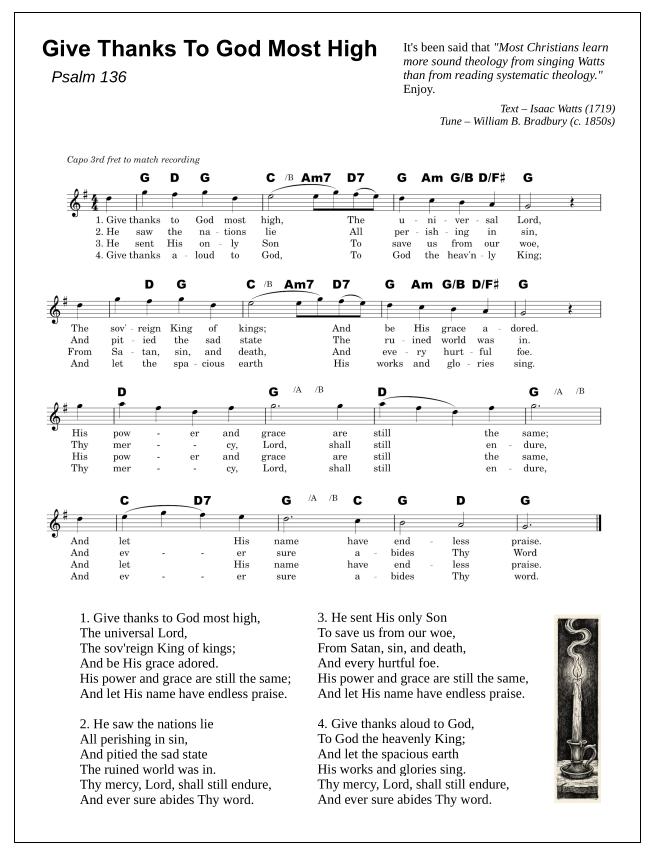
Download this song sheet from The Music Box
LYRICS – Give Thanks To God Most High
Text – Isaac Watts (1719)
Tune – William B. Bradbury (c. 1850s)
1. Give thanks to God most high,
The universal Lord,
The sov’reign King of kings;
And be His grace adored.
His power and grace are still the same;
And let His name have endless praise.
2. He saw the nations lie
All perishing in sin,
And pitied the sad state
The ruined world was in.
Thy mercy, Lord, shall still endure,
And ever sure abides Thy word.
3. He sent His only Son
To save us from our woe,
From Satan, sin, and death,
And every hurtful foe.
His power and grace are still the same,
And let His name have endless praise.
4. Give thanks aloud to God,
To God the heavenly King;
And let the spacious earth
His works and glories sing.
Thy mercy, Lord, shall still endure,
And ever sure abides Thy word.

Say hello … leave a note … add your thoughts
Please feel free to add your thoughts to this conversation in the “Leave a reply” spot below.
So much to be thankful for.♥
Praying you and Cathy have a wonderful Thanksgiving♥
Thankful for your music ministry.